
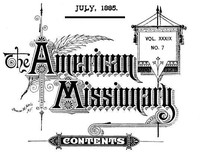
The American Missionary — Volume 39, No. 07, July, 1885 by Various
This isn't your typical book. 'The American Missionary — Volume 39, No. 07, July, 1885' is a single issue of a monthly journal published by the American Missionary Association. There's no single author or plot. Instead, it's a collection of field reports, letters, financial statements, and editorial pieces from the front lines of post-Civil War mission work, primarily focused on educating African Americans in the South.
The Story
Imagine opening a magazine and finding the unvarnished mail from people doing difficult work. That's this. The 'story' is told through dispatches. A teacher writes from a rural Alabama schoolhouse, listing how many students she has and the textbooks they lack. A superintendent in South Carolina details the challenges of finding land for a new school while local opposition simmers. There are lists of donations—$5 from a church in Vermont, barrels of clothing from New York. Interwoven are arguments about the mission's direction: Should they just preach, or was building schools and teaching trades the real path to freedom? The narrative that emerges is one of a fragile network of people and resources trying to hold the line for progress against enormous social and economic pressure.
Why You Should Read It
I found this absolutely gripping, but not in a fun, escapist way. It's the gritty paperwork of idealism. What got me was the immediacy. History often feels settled, but these pages are full of uncertainty and urgency. You feel the anxiety in a letter worrying about the next month's rent for a dormitory. You see the deep paternalism in some articles, and then you read the simple, powerful words of a Black teacher asserting her community's needs. It complicates the easy story of 'North helps South.' It shows the friction, the misunderstandings, and the sheer hard work. Reading it feels like eavesdropping on a critical conversation about race, charity, and nation-building that we're still having today.
Final Verdict
This is a specialist's treasure and a curious reader's deep dive. It's perfect for history buffs, educators, or anyone interested in the roots of America's racial and educational struggles. If you love primary sources and want to move beyond textbook summaries of Reconstruction, this is pure, uncut material. It's not for someone looking for a smooth narrative or a light read—it's fragmented, dated in language, and often sobering. But if you're willing to meet it on its own terms, it offers a perspective no modern history book can fully replicate. You're not just reading about history; you're holding a piece of it, stains and all.
Joshua Thompson
2 months agoAfter hearing about this author multiple times, it manages to explain difficult concepts in plain English. Don't hesitate to start reading.
Liam Martinez
3 months agoAs someone who reads a lot, it manages to explain difficult concepts in plain English. Worth every second.
Sandra Miller
6 months agoI was skeptical at first, but it challenges the reader's perspective in an intellectual way. I would gladly recommend this title.
Michelle Taylor
1 year agoFrom the very first page, the arguments are well-supported by credible references. Exactly what I needed.







Susan Ramirez
2 months agoRead this on my tablet, looks great.