
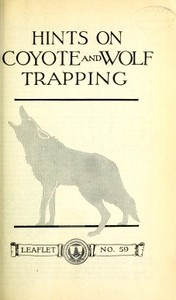
Hints on Wolf and Coyote Trapping by Stanley Paul Young
Stanley Paul Young's Hints on Wolf and Coyote Trapping is exactly what it says on the tin: a practical guide. Published in the early 1900s, it was written by a government trapper for other trappers. The 'plot,' if you can call it that, is the methodical process of outsmarting two of North America's most clever canines. Young walks you through it all—identifying tracks, understanding habits, selecting locations, and constructing various traps. He details everything from simple steel jaws to complex 'cubby sets' using logs and bait. The prose is direct, technical, and completely unemotional.
The Story
There's no character arc or dramatic climax. The 'story' is the quiet, persistent conflict between ranchers protecting their stock and wolves or coyotes following their instincts. Young positions himself as the expert problem-solver, providing the tools to tip the scales. Each chapter is a step in a lethal process, building a clear picture of a widespread, government-sanctioned campaign to control predator populations. The narrative drive comes from the sheer, focused intensity of the pursuit it describes.
Why You Should Read It
You read this book for the context, not the content. On its own, it's a technical pamphlet. But when you place it in history, it becomes fascinating. This manual was a weapon in a real ecological war. Reading it today feels like holding a artifact. You get an unfiltered look at the mindset of an era that saw predators purely as 'varmints' to be eradicated. There's a haunting quality to Young's calm instructions. It forces you to confront the hard choices and stark philosophies that shaped the American West, long before modern conservation ethics took hold. It’s a sobering reminder of how much our relationship with wildlife has changed—and in some places, how much it hasn't.
Final Verdict
This is a niche but powerful read. It's perfect for history buffs, wildlife enthusiasts, or anyone interested in the American West beyond the myth. If you've ever wondered about the gritty realities of frontier life or the roots of modern wildlife management (and conflict), this primary source is invaluable. It's not a fun adventure tale; it's a cold, hard look at a chapter of our environmental past. Approach it with curiosity and historical perspective, and you'll find it's surprisingly gripping in its own stark way.
Elijah Walker
1 year agoWithout a doubt, the arguments are well-supported by credible references. Truly inspiring.
Emily Hernandez
1 year agoComprehensive and well-researched.
Ashley Sanchez
3 months agoI have to admit, it challenges the reader's perspective in an intellectual way. I couldn't put it down.
Kimberly Moore
6 months agoComprehensive and well-researched.







Elizabeth Scott
6 months agoI came across this while browsing and the storytelling feels authentic and emotionally grounded. I learned so much from this.