
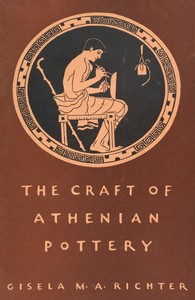
The Craft of Athenian Pottery by Gisela M. A. Richter
Let's be clear from the start: this isn't a novel. There's no sweeping plot with heroes and villains. Instead, Gisela Richter gives us something just as compelling—the step-by-step story of how an Athenian pot was born.
The Story
Richter walks us through the entire life of a pot, from the Athenian clay pits to the finished product. She explains how the clay was dug and purified, how the potter threw shapes on a kick-wheel (a technology that feels both ancient and familiar), and how these fragile forms were dried and fired. Then, she takes us into the painter's world. We learn how they mixed their paints, sketched intricate designs, and applied the famous black and red glazes that have survived for millennia. The 'conflict' here is the constant battle against physics and chemistry—preventing cracks in the kiln, controlling the fire to get that perfect glossy black, and mastering a brushstroke that couldn't be erased. It's a story of skill, patience, and problem-solving.
Why You Should Read It
What makes this book special is Richter's voice. She writes with the quiet confidence of someone who has handled these pots, studied their seams, and asked the practical questions. She doesn't just tell you Athenian pottery was great; she shows you exactly why and how it was so masterful. You start to see the individual choices—the decision to make a stem slightly thicker for balance, the economic reason for standardizing certain shapes. It turns anonymous artifacts into products of real human intelligence. After reading it, a museum visit becomes a different experience. You're not just looking at a picture of a god; you're appreciating the steady hand that drew the line and the clever potter who shaped the canvas.
Final Verdict
This book is perfect for anyone with a curiosity about how things are made, especially the beautiful things of the past. It's for the museum-goer who wants to look deeper, the history lover tired of only political narratives, or the artist or crafter interested in ancient techniques. It's not a light read, but it's a deeply satisfying one. Richter gives you the tools to become a more informed observer, to see the genius in the craft. You'll close this book with a newfound respect for the ancient artisans whose work continues to speak to us.
Sarah Nguyen
2 months agoVery helpful, thanks.
Noah Clark
7 months agoSimply put, the arguments are well-supported by credible references. Truly inspiring.
Patricia Gonzalez
1 year agoHonestly, the narrative structure is incredibly compelling. Exactly what I needed.
Susan Flores
1 year agoFinally a version with clear text and no errors.










Noah Ramirez
11 months agoJust what I was looking for.