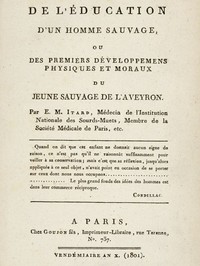
De l'éducation d'un homme sauvage by Jean Marc Gaspard Itard
Published in 1801, this isn't a story someone made up. It's the actual report written by Dr. Jean Marc Gaspard Itard, a young physician working at the National Institute for the Deaf in Paris. The French government brought him a unique case: a boy who had been captured in the forests of Aveyron. The child, estimated to be about 12, showed no signs of human socialization. He was mute, indifferent to others, and obsessed with escaping back to the wilderness.
The Story
Itard names the boy Victor and dedicates himself to a monumental task: to prove that Victor's condition is due to isolation and neglect, not an innate lack of intelligence. The book is Itard's step-by-step log of his methods. He starts with basic needs, using food and warmth to build trust. He tries to teach Victor to speak, with limited success—Victor learns to understand many words but can only vocalize a few sounds. Itard has more luck teaching him to read simple words and to perform tasks. We see Victor learn to dress himself, set a table, and even show flashes of emotion, like affection for his caretaker, Madame Guérin. But progress is painfully slow and mixed with setbacks. The core drama is the constant push-and-pull between Victor's emerging humanity and his deep, ingrained wildness. The experiment ends not with a triumphant success, but with a complicated, ambiguous result.
Why You Should Read It
What grabs me about this book is its raw honesty. Itard doesn't hide his frustrations or Victor's failures. You feel his hope when Victor learns a new skill, and his defeat when the boy reverts to old habits. It’s a powerful, intimate look at the very foundations of education and connection. Victor isn't a character; he was a real person, and that makes every page feel urgent. The book forces you to think about what we take for granted: how we learn to love, to communicate, to belong. It’s also a stark reminder of how much early childhood experience shapes who we become.
Final Verdict
This is a must-read for anyone interested in psychology, education, or simply profound human stories. It’s perfect for fans of true historical accounts that read like intellectual detective stories. While the language is from the 19th century, the questions it raises are timeless. Be prepared—it’s not a light or easy read emotionally, but it’s a short, impactful one that will stick with you long after you finish. If you've ever read about cases like Genie or feral children and wanted to go to the source, this is where it all began.