
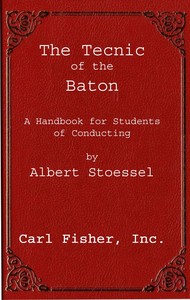
The technic of the baton : a handbook for students of conducting by Stoessel
Forget everything you think you know about conducting being all about wild hair and intense stares. Albert Stoessel's The Technic of the Baton is the opposite of that. Published in 1943, it's a straightforward, nuts-and-bolts instruction manual. Stoessel, a respected conductor and teacher, isn't writing a memoir or a book of criticism. He's writing a textbook for the body.
The Story
There's no narrative plot, but there is a clear journey: from how to properly hold the baton to executing complex rhythmic patterns. Stoessel methodically walks a student through posture, the basic 'beat patterns' (the shapes you draw in the air for different time signatures), and how to clearly signal dynamics, cues, and cut-offs. He uses simple diagrams and clear language. The 'story' is the transformation of a person from someone who knows music into someone who can physically lead it. He covers the practicalities—what to do with your left hand, how to handle tempo changes—with the precision of a drill sergeant. It's less about interpreting Beethoven and more about making sure the violins all start together.
Why You Should Read It
This book is a revelation for any music fan. It turns the conductor from a mystical figure into a skilled technician. Reading it, you gain a new appreciation for the craft. That tiny flick of the wrist? It's a specific instruction. That large, sweeping arc? It's controlling volume and phrase. Stoessel's writing, while technical, comes from a place of deep desire for clarity and unity. You feel his frustration with sloppy, showy conducting and his commitment to efficiency. It makes watching any orchestra concert a richer experience. You start to see the language being spoken, not just hear the results.
Final Verdict
This is a must-read for aspiring conductors, of course, but it's also perfect for curious orchestra musicians, dedicated concert-goers, and anyone who loves seeing 'how things work.' It's not a casual beach read, but it's surprisingly accessible. Think of it as a backstage pass to the conductor's mind and muscles. If you've ever said, 'I just don't get what the conductor does,' this compact handbook from the last century will give you a clearer answer than a dozen modern documentaries.
Paul King
11 months agoJust what I was looking for.
Kimberly Martinez
1 year agoAmazing book.
Joseph Smith
1 year agoSolid story.
Patricia Thomas
4 months agoCitation worthy content.






Oliver White
2 months agoJust what I was looking for.